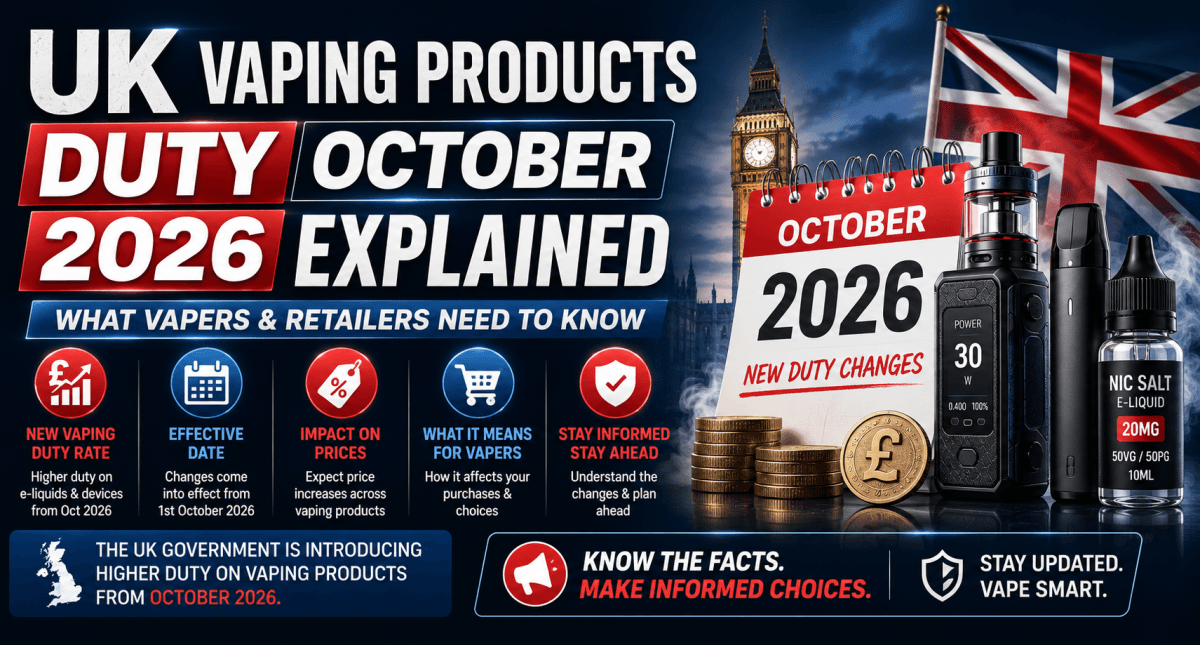
UK Vaping Products Duty October 2026 Explained
Tags Cloud
UK Vape Tax 2026: What the October Duty Means for You
From 1 October 2026, a new tax called the Vaping Products Duty (VPD) adds £2.20 to every 10ml of vaping liquid sold in the UK. That covers nic salts, standard e-liquids and nicotine-free shortfills alike — it doesn’t matter whether the bottle contains nicotine or not, the duty applies per 10ml of liquid. Devices, pods, coils and batteries aren’t affected; this is a liquid duty, not a hardware tax.
Here’s what’s actually changing, what it means for your regular order, and what’s worth knowing if you want to plan ahead.
Contents
What is the Vaping Products Duty?
The Vaping Products Duty is a new excise tax, similar in structure to the ones already applied to alcohol and tobacco. It was first announced at the Autumn Budget in 2024, and HMRC has spent the time since building the compliance system around it — including a Vaping Duty Stamps scheme, which requires visible proof that duty has been paid on any bottle sold from October onwards.
It sits alongside standard VAT rather than replacing it, so this is a genuine addition to the price of a bottle of e-liquid, not a restructuring of existing tax.
How much extra will I pay?
The duty is charged at £2.20 per 10ml. In practical terms:
- A single 10ml nic salt bottle: +£2.20
- A 50ml shortfill: +£11.00
- A 100ml shortfill: +£22.00
This applies at the point of manufacture or import, so the cost works its way through the supply chain and into shelf prices — it isn’t something added separately at checkout.
Does the duty apply to nicotine-free e-liquid too?
Yes. This catches a lot of people out. The duty applies to any liquid intended for vaporisation in a vape device, regardless of nicotine content — so 100ml shortfills, which are nicotine-free by law under separate TPD rules, are taxed the same as a 10ml nic salt bottle on a per-10ml basis. If anything, shortfills feel the change more, simply because the bottles are bigger.
What about devices, pods and coils?
Hardware is unaffected. Vape kits, pod kits, coils, batteries and chargers don’t carry any vaping liquid duty — the tax is specifically on the liquid itself, not the equipment used to vape it.
What's a duty stamp, and why does it matter to me as a buyer?
From 1 October 2026, new vaping liquid stock needs to carry a duty stamp showing the tax has been accounted for. Retailers themselves don’t need to apply for approval — that responsibility sits with manufacturers, importers and warehouse keepers further up the supply chain — but it does mean genuine, compliant stock will visibly carry this stamp going forward. Existing unstamped stock can still be sold under transitional rules until 31 March 2027, after which everything needs to carry a stamp.
For you as a customer, this is worth knowing mainly as a way to sense-check what you’re buying: from April 2027 onwards, e-liquid without a duty stamp isn’t compliant stock.
Is there anything I can do before October?
If you already know which nic salts or e-liquids you’ll keep reordering, buying ahead of 1 October means locking in pre-duty pricing on stock that’s still sitting on shelves. It’s not a loophole — it’s simply that duty applies going forward from the point of manufacture, not retroactively to stock already produced. Once existing stock sells through, prices reflect the new duty.
If you’re a regular nic salt user, our box deals collection is a straightforward way to stock up in bulk before the change lands. Our full nic salts and e-liquids ranges remain unaffected until existing stock cycles through.
Sources: GOV.UK — Introduction of Vaping Products Duty from 1 October 2026, Business Companion — Vaping Products Duty: what retailers need to know, HMRC Vaping Duty Stamps Scheme tender documentation.